
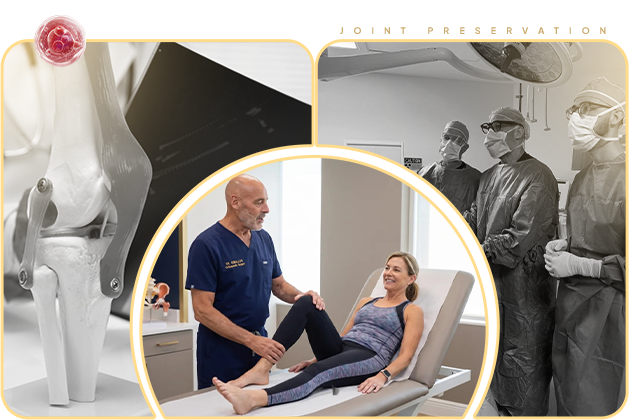
Dr. Ceballos Dual Board-Certified Orthopedic Surgeon & Sports Medicine Specialist
Joint preservation isn’t a service on my menu. It’s the philosophy every other page on this site is written in service of. Needle arthroscopy, orthobiologics, the MISHA Knee System none of these are separate businesses I happen to also offer. They’re expressions of the same underlying belief: a joint should be replaced only when every reasonable option to preserve it has genuinely been exhausted, not simply because replacement is easier to schedule.
For too long, orthopedic surgery has treated arthroscopy, biologics, and joint replacement as separate, disconnected services you get referred from one to the next as each fails. I built my practice differently. Every tool below exists inside one strategy, evaluated for one goal: keep your native joint working for as long as it safely can.

Joint preservation isn’t limited to one joint. The same diagnose-precisely, treat-early, preserve-anatomy approach applies across the knee, shoulder, hip, and elbow the specific tools change with the joint and the pathology, but the strategy doesn’t. Whether it’s a knee with early medial compartment wear, a shoulder with a partial rotator cuff tear, or an elbow with cartilage changes from years of overhead load, the evaluation starts from the same question: what can be preserved here, and how?

For active adults with early-to-moderate osteoarthritis who aren’t ready for or don’t want joint replacement, preservation strategies can meaningfully change the trajectory. PRP, BMAC, or stem cell therapy to support the joint’s own healing environment, and, for appropriately selected knee patients, the MISHA Knee System to offload the damaged compartment mechanically. Not every patient with osteoarthritis is a preservation candidate some structural damage genuinely requires replacement, and I’ll tell you directly when that’s the case.
Focal cartilage defects, particularly in younger and more active patients, are treated with an eye toward repair and augmentation rather than removal. Needle arthroscopy lets me see the cartilage surface directly, in real time, so the decision about whether to preserve, augment, or address a defect surgically is based on what I’ve actually seen not an inference from an MRI.

Where the tissue and the tear pattern allow it, I prioritize meniscus repair and preservation over removal. A preserved meniscus continues to protect the joint surface it was designed to protect; a resected meniscus does not, which accelerates the same degenerative process joint preservation is built to slow down. Needle arthroscopy and, when appropriate, orthobiologic augmentation both support this approach.

Areas of bone marrow edema or early subchondral bone change bone marrow lesions are a common, under-treated driver of joint pain, often present before significant cartilage loss shows up on an X-ray. Identifying and treating a bone marrow lesion is part of a joint-preservation strategy, not a stand-alone fix, and is addressed through the subchondral bone and intraosseous approaches below.

Not all joint damage originates at the cartilage surface the bone directly beneath it is frequently part of the problem, particularly in early-to-moderate osteoarthritis. Addressing the subchondral bone directly, rather than treating the joint space alone, is part of how I approach preservation for patients whose imaging shows this pattern.
For patients with bone marrow lesions or subchondral bone involvement, I deliver PRP or, in select cases, cellular therapy directly into the bone under image guidance rather than into the joint space alone. This targets the bone itself as a pain generator and potential contributor to cartilage breakdown, and is often used alongside intra-articular treatment for a more complete approach to the joint.

For appropriately selected patients with medial compartment knee osteoarthritis, MISHA offloads the damaged compartment mechanically, without removing bone or replacing the joint. It’s joint preservation made mechanical addressing the biomechanical load causing the damage directly, rather than only resurfacing over it. I was the first Miami-Dade physician trained in this system.

When a structural repair is genuinely needed, I favor the least invasive approach that can still get the job done needle arthroscopy for many diagnostic and select therapeutic procedures, often performed in-office or in an ambulatory setting, rather than a traditional open or larger arthroscopic approach when it isn’t required.

If you’ve been told you need a joint replacement, or you suspect you’re heading toward one, the conversation I want to have with you starts earlier than that. What does direct visualization actually show? Is there a biologic or mechanical intervention that changes your timeline? Alternatives orthobiologics, MISHA, meniscus or cartilage preservation are evaluated before replacement becomes the only conversation left to have.
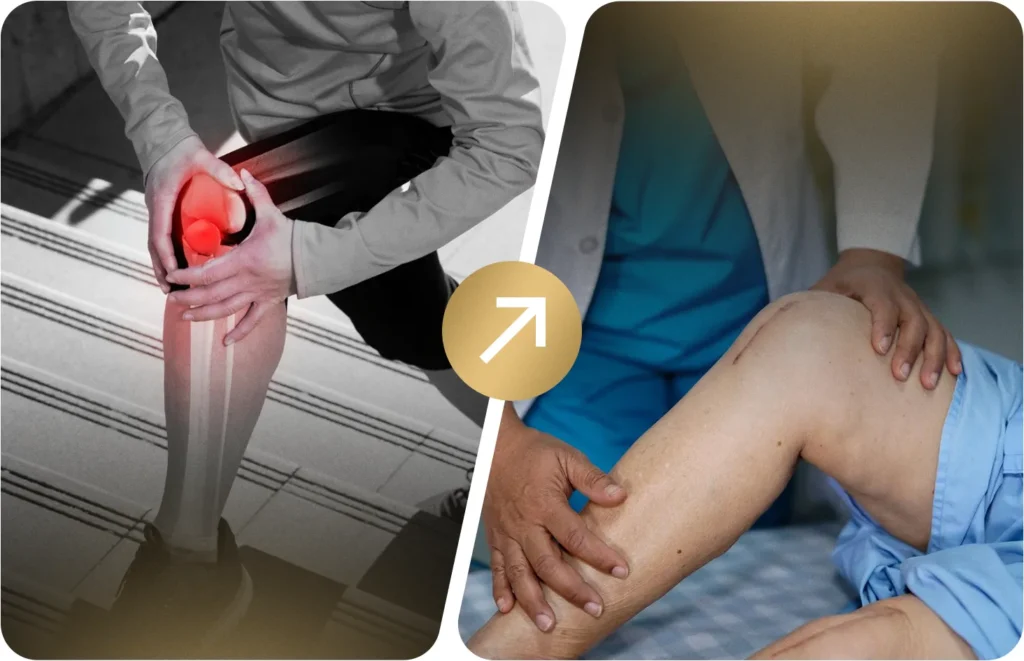
Joint preservation isn’t the right answer for every patient or every joint some structural damage genuinely requires replacement, and I’ll say so directly rather than delaying a conversation you actually need to have. Choosing preservation first doesn’t close that door: needle arthroscopy, orthobiologics, and MISHA are all designed to leave future options intact, including joint replacement later if your joint’s condition ultimately requires it.
Because I perform the arthroscopic evaluation, the biologic therapies, and the mechanical interventions myself, a joint preservation strategy at my practice isn’t assembled from separate specialists who don’t talk to each other. I can move from direct visualization, to biologic augmentation, to a mechanical solution like MISHA, to if it’s genuinely necessary a surgical repair, all within one continuous relationship.

A joint preservation strategy is only as good as the judgment connecting its pieces. Because I perform the arthroscopic evaluation, the biologic therapies, and procedures like MISHA myself, your joint preservation strategy is built and managed within one relationship rather than assembled from referrals across multiple offices.

Joint preservation strategies, including needle arthroscopy, orthobiologic therapies, and the MISHA Knee System, are not appropriate for every patient or every joint condition. Some of the biologic therapies referenced are investigational and not FDA-approved for specific orthopedic indications. A comprehensive orthopedic evaluation is required to determine candidacy for any preservation strategy, and individual outcomes vary. A physician-patient relationship is established only after consultation and informed consent.
It means treating your native joint as worth protecting for as long as it can reasonably be protected using precise diagnosis, early intervention, biologic support, and mechanical strategies like MISHA before joint replacement becomes the answer, rather than assuming replacement is inevitable.
Not always, and I won’t tell you it is. For patients with advanced structural damage, replacement genuinely is the right answer, and I’ll say so directly. For appropriately selected patients with earlier-stage disease, preservation strategies can delay or, in some cases, avoid replacement altogether.
It starts with direct visualization and imaging to understand exactly what’s happening in the joint. From there, the decision depends on the specific pathology, your activity goals, and how far the joint’s degeneration has progressed. Sometimes it’s one tool; often it’s a sequence.
No. I perform the arthroscopic evaluation, the biologic therapies, and procedures like MISHA myself, which means your joint preservation strategy is built and managed within one relationship rather than assembled from referrals across multiple offices.
Choosing preservation first doesn’t close that door. Needle arthroscopy, orthobiologics, and MISHA are all designed to leave future options intact, including joint replacement later if your joint’s condition ultimately requires it.
No. While many of my patients are current or former athletes, joint preservation is relevant to any active adult who wants to protect their mobility.